Unknown's avatar

About Chuck Spindler

I am a retired pastor after serving in the same church for 30 years in Creston, Iowa. Adjusting to widowhood and retirement in the same year has been rough, but I'm traveling more, visiting my kids and grandchildren, and enjoying my photography hobby (www.cspindlerphoto.com).

Tips for Refreshment

Last week I wrote on the importance of refreshment and maintaining a regular time with God in honest recognition of His reign over your life.  Jesus found it necessary to withdraw to the lake, to the mountain, or beside the road to be alone with God. He needed rest and renewal in order to go back among the throngs of people. If he needed it, we need to make sure that we incorporate a time of refreshment into our busy lives. That doesn’t mean just laying around all day (although it may mean sleeping until you wake up on your own instead of by an alarm clock). But, we should purposefully center our rest and renewal around these suggested areas:

1)  A time to stay at home: Families are going in so many different directions today. Finding some time to recoup as a family by doing something special on a weekly basis helps to reconnect and refresh. You also model to your children the value of family time and the life-long, vital connections that are made early in life (remember the message of Cats in the Cradle).

2)  A time to read, study and write: I talked to someone the other day, who, in the process of writing out her Christian testimony, has been reminded of all the ways in which God was working in her life when she didn’t even realize it. This revelation brought a sense of excitement and joy. Reading Christian biographies and inspirational books will also buoy your spirit. Additionally, with life and societal changes always happening, there is the need to stay current and retool. Do you carve a niche in your schedule for reading, studying, writing, and concentrating on new subjects and new interests?

3)  A time to play and serve: Some playtime should be a part of renewal and rest. Playtime might include long hikes, participation in an enjoyable sport, unstructured playtime with the family, and trips to historic locations. It could also include an outreach work project, such as an emergency disaster project. Serving in ways out of our normal area of ministry is surprisingly energizing.

4)  A time to enjoy the beauty of life: Beauty in nature offers many benefits. Very beautiful scenes are often in quiet places. Beauty stimulates the senses. In such a setting, it is easy to get in tune with the Creator.

The heavens declare the glory of God,
and the sky proclaims the work of His hands.
Day after day they pour out speech;
night after night they communicate knowledge

(Psalm 19:1-2, HCSB)

5)  A time for Bible study and prayer: This is a very important part of restoration. It can take place along with some of the other experiences at times (as in nature). This is a time to read those things that focus on praising God through inspirational books, poems, and hymns, including meditation and reflection.

These are only a few suggestions, but don’t neglect this vital area of your life. Medical science has demonstrated that the effects of rest are significant, indicating the great role that rest can play in our physical and emotional well-being.

Points to Ponder:

  • If you have a family at home, what are (or have been) your suggestions for ways in which your family has found refreshment together (board games, outdoor activities, camping, etc.) Leave comments!
  • What have you found to be the best way for you to find replenishment for body, soul and spirit?

Finding Refreshment

Our Iowa heat wave has me reminiscing about the heat and humidity of my Tennessee, childhood summers. We had a two-story (split into four-levels) home with only two, window unit air conditioners —one in the dining room (2nd level) and the other in my parents’ top level bedroom.  I guess my father felt the units were strategically placed since cold air falls, but they really couldn’t keep up with the demands of Memphis summers. After some hard, outdoor play, I can remember heading in for a drink of water or Kool Aid and then lingering in front of the window unit. The cold air from condensation-laden vents came as a welcome relief from an afternoon of play outside.  Refreshed, I would head back out for some more games of baseball, kickball or army with my friends, Steve and Kendall.

What are you doing to find refreshment for your body, soul and spirit? I have received some unsolicited (but caring) advice about my need to make sure I have some times of refreshment built into my schedule. The fact of the matter is, we all need to make sure we have that refreshment…not as an excuse for laziness but as a way of re-energizing for service to the Lord. In Exodus 31, Moses concludes his time with God on Mt. Sinai and the Lord said this:

16 The Israelites must observe the Sabbath… 17 It is a sign forever between Me and the Israelites, for in six days the LORD made the heavens and the earth, but on the seventh day He rested and was refreshed.

If God “rested and was refreshed,” might we not also need to experience the same?

The most essential and primary way to experience refreshment comes from repentance. Peter said in Acts 3:19:

Therefore repent and turn back, that your sins may be wiped out so that seasons of refreshing may come from the presence of the Lord.

Repentance from sins is a necessity for ongoing, unrepentant sin causes our fellowship with the Lord to be interrupted. Intimacy with God is compromised just as it is in a marriage when a spouse will not admit and make steps of restitution following an indiscretion. Thus, repentance may be your first step back to needed times of refreshment.

More on “refreshment” next time.

Points to Ponder

  • Are there any actions or attitudes in your life from which you need to turn in order that a floodgate of needed refreshment might open onto your life, enabling you to experience the presence of the Lord, again?
  • Think of a time of personal, spiritual refreshment. Did repentance precipitate the refreshment?

The Spirit’s Groans

When people consider coming to our church, some phone first with a question or two.The number one question is, “What time is your service?”  Very seldom are there any questions about doctrinal issues. However, there are a few who base their first attendance on very specific issues.

One group’s number one question is: “What translation of the Bible do you use?” This is always a question coming from the ones who believe the King James Version is the only proper translation to use. A fundamental Baptist church in Ft. Worth posted on their church sign: “The King James Version – The Only Inspired Word of God, The Bible God Reads.” I’m sorry, but that is wrong on so many levels that I don’t think I need to explain.

Another group will ask, “What is your position on TULIP?” [1]  I respond that I love flowers and enjoy the Pella Tulip Festival. Seriously, though, this question comes from the Five-Point Calvinists, and if you really press me, I’m only up to 3½ points.

Other questions are far less frequent. I was once asked if we had any images of Jesus in our church. I said “No,” until I remembered the stained glass image that was behind the pulpit representing Christ’s teaching of the Soils. Positions on end-time doctrine occasionally surface, to which I respond, “I’m a pan-millennialist. It will all pan out in the end.” I can say with confidence that Christ will return bodily, and gather His followers to enjoy eternity in the presence of God. Everything leading up to that event is subject to great debate and for anyone to say their position is the correct one is divisive.

Some ask, “What do you believe about speaking in tongues?” My response for the first-time questioner as it relates to church gatherings is that we practice Paul’s admonition in 1 Corinthians 14 – that is, tongues are discouraged.

9Unless you speak intelligible words with your tongue, how will anyone know what you are saying? You will just be speaking into the air.10 Undoubtedly there are all sorts of languages in the world, yet none of them is without meaning. 11 If then I do not grasp the meaning of what someone is saying, I am a foreigner to the speaker, and he is a foreigner to me. 12 So it is with you. Since you are eager to have spiritual gifts, try to excel in gifts that build up the church.

All spiritual gifts are to benefit others, not just ourselves. Thus, Paul says that the gift of tongues should be used only if the words are able to be interpreted, for the purpose of building up the church. Interestingly, in all my years of ministry no one has ever said to me, “I have the gift of interpretation.” And because Paul is addressing a problem in the church at Corinth, he (who had the gift of tongues) said he would rather speak five intelligible words in order to instruct the church than 10,000 words in a tongue.

While I do not fall into the camp that says the gift of tongues is no longer operational today, I do believe that the contemporary expression of tongues which I have observed does not fall in line with the New Testament manifestation. In Acts 2, the crowd in Jerusalem heard the apostles speaking in their own languages. These were known languages and a means of communicating to Jewish pilgrims from other countries. In the two other occasions in Acts where tongues are mentioned, it appeared at the outset of conversion, it was spontaneous and it was intelligible. When tongues are characterized today as a gift that can be learned/taught, a gift to be sought above all others and proof of one’s spiritual development, it is taken out of the realm of the spiritual and becomes a sign of carnality.

Regarding our study in Romans, Paul says that the Spirit:  “…helps us in our weakness. We do not know what we ought to pray for, but the Spirit himself intercedes for us with groans that words cannot express” (Romans 8:26, NIV). Some make the case that the Spirit’s groans are a “spiritual prayer language” practiced by believers. However, the word “groans” refers to “intense, yet inaudible, sighing.” Ray Stedman is one among many, who makes a good case for why this verse is not an example of speaking in tongues:

I have always been amazed at people who emphasize the gift of tongues and take this verse as proof that the Spirit prays in tongues through us. This verse could not mean that. Paul tells us that this praying of the Spirit is done with groans which words cannot express. Now, tongues are words, words of other languages. If this referred to the gift of tongues, it would merely be putting into other languages the feelings of our heart. But this passage has nothing to do with that. This describes the groans of the Spirit within, so deep and so impossible to verbalize that we cannot say anything at all. We just feel deeply. The apostle says that when that happens, it is the Spirit of God who is praying. The Spirit is putting our prayer into a form which God the Father, who searches the heart, understands. The Spirit is asking for something concerning the situation that we are trying to pray about. [2]

Putting aside the issue of tongues, we can still see in this passage (Romans 8:26) the incredible ministry of the Spirit. What a wonderful assurance it is to know that even in our times of groaning there is the close identification and help of the Paraclete – the Intercessor – who prays for us when we don’t even know how to pray. What a blessing it is to know that not only does the Spirit intercede, but Christ, being at the right hand of the Father, does so as well (Romans 8:34). With that kind of power and insight helping us in our prayers, we can expect that God “is able to do far more abundantly beyond all that we ask or think, according to the power that works within us” (Ephesians 3:20, NASB).

Your Response:

  • What is it that you consider of primary importance when visiting a church?
  • Have there been times in which you did not know how to pray but sensed a peace as the Spirit took over?
  • Do you have an understanding of your own spiritual gift and how the Spirit operates through you to edify (build up) the church? We’ll consider this more in Romans 12, but resources are available through our church if you need some direction in this area. Contact us.

______________________________________________________________

1. For those unfamiliar with the five points of Calvinism, they are:

  1. Total depravity
  2. Unconditional election
  3. Limited atonement
  4. Irresistible grace
  5. Perseverance of the saints

2. Ray Stedman, Sermon: The Agony and the Ecstacy at http://www.pbc.org/messages/the-agony-and-the-ecstasy

Conforming to Christ

28 And we know that in all things God works for the good of those who love him, who have been called according to his purpose. 29 For those God foreknew he also predestined to be conformed to the likeness of his Son, that he might be the firstborn among many brothers.     

Romans 8:28-29

As one of the top five online “most searched” verses [1],  Romans 8:28 is often taken out of context. There are several things it doesn’t mean.

First, this doesn’t say that all things are “good.” The Bible never implies that war, disease, divorce, abuse, injustice, tragedy, immorality, and on and on are good things.  Second, it doesn’t say our definition of “good” matches God’s definition of “good.”  Our preference would be not to go through any difficulty in life, and we define “good” as what is most pleasant at the time. Third, this is not a universal truth. Good is not ultimately experienced by all, but only those who love God (i.e, Christians). Fourth, this promise does not say that we will always see or understand the good that God is doing.  Whether it is the death of a child, a divorce, or a tornado destroying your home, we may never understand the “why” this side of eternity. But, just because we don’t understand doesn’t mean these things are not being used for God’s purposes.

The surrounding verses are key (as in all scripture interpretation) to understanding its meaning. In the context of Chapter 8, Paul earlier says, I consider that our present sufferings are not worth comparing with the glory that will be revealed in us (Romans 8:18, NIV). Then, as a consequence of the Fall of mankind into sin, he speaks of the resulting groans of creation, believers and even the Holy Spirit as we look forward – through the sufferings – to the glory to come in Christ’s return. Our present wait is much like the labor of childbirth, though painful and difficult at the time, it results in the blessed arrival of a child. When Christ in glory returns, all suffering will be over for the children of God and creation. (Revelation 21:1-4)

We may never fully realize the “good” God is working this side of glory. However, if we know that God is working in all our circumstances, including our present sufferings, to conform us to the likeness of Christ, we can approach the joys and sorrows of life with a different attitude. We are better able to endure those difficulties when we know that God is preparing us for glory through the sanctifying process of conforming us to more completely resemble Christ.

Your Response:

Instead of having a “pity party” next time things don’t seem to go your way, pause to consider:

  • What is my normal, natural, fleshly response in this circumstance?
  • While a seemingly trite phrase, take seriously the question, “What would Jesus do?”
  • What fruit of the Spirit (love, joy, peace, patience, kindness, goodness, faithfulness, gentleness or self-control) is lacking in you that God may be using this circumstance to conform you into the likeness of Christ?
________________________________________________________________________

1 Romans 8:28 was #5 in 2011, down from #3 in 2010 on the Five Most Popular Verses at the Bible Gateway website

Creation’s Groans

No matter which side of the environmental/man-made global warming debate you take, we all have to agree that the earth is not in the pristine shape in which it was created. From the Christian worldview, there is the understanding that God created the universe, and in the beginning, it was all good! Man and nature lived in wonderful harmony…there was no sense of enmity or predatory temperament between animals or man. All was in oneness with God, too. Creation was spoken forth and what comes forth from God is necessarily in harmony with His character.  At the end of the act of creation, God was satisfied as indicated by his “rest” from creation on the seventh day. It was finished!

In that final day of creation, God created man in a unique sense – “in Our image” – with the responsibility to “rule over the fish of the sea and over the birds of the sky and over the cattle and over all the earth, and over every creeping thing that creeps on the earth (Genesis 1:26, NASB).  As chapter 2 of Genesis gives an expanded view of the sixth day of creation, we see that Adam was given this responsibility:  “The LORD God took the man and put him in the Garden of Eden to work it and take care of it”  (Genesis 2:15, NIV)He was to be a husbandman (farmer) who protected the land.  This was work but it would not be frustrated labor.

However,  with Adam and Eve’s rebellious decision to disobey God, a curse came not only  upon man but on nature, as well:

 17 To Adam he said, “Because you listened to your wife and ate from the tree about which I commanded you, ‘You must not eat of it,’ “Cursed is the ground because of you; through painful toil you will eat of it all the days of your life.

18 It will produce thorns and thistles for you, and you will eat the plants of the field.

19 By the sweat of your brow you will eat your food until you return to the ground, since from it you were taken; for dust you are and to dust you will return.”  (Genesis 3:17-19, NASB)

Thus, creation was brought down to the level of death and decay – not God’s original intent – but subjected by God to this level because of man’s disobedience.  Man’s sin then, as now, had a ripple effect and even creation was impacted by man’s sin.

What are we to do, then? Can creation be restored by our efforts to do away with greenhouse gases, lessening our carbon footprint or enforcing radical population control? No! Paul suggests that the only way creation will be restored to its original intent is when Christ returns and man is glorified. The creation waits in eager expectation for the sons of God to be revealed (Romans 8:19, NIV).There is a wonderful picture in this verse in the phrase “waits in eager expectation.”  It is the idea of someone on their tiptoes, straining forward to gain a perspective of something to come.  The closest mental picture I get of this would be of the crowds on the parade route, waiting for the Royals’ carriage or motorcade to pass by. As word comes of its approaching, people are straining to catch a glimpse as the King and/or Queen passes. In the same sense, creation is essentially straining to see the sight of the King of kings, returning and God’s children coming into their glory. This will also be the day of liberation for creation for which it anxiously awaits (Romans 8:21).

Until then, creation is groaning as in the pains of childbirth. The groans are for glory and as we’ll see next week, we share in those groanings.

YOUR RESPONSE: 

  • In light of our inability to restore creation to its pristine state, we still have the God-given responsibility to be stewards of creation as it is. In what ways are you practicing conservation of resources, enabling future generations to benefit from God’s resources.
  • Much of the environmentalism of today smacks of “creation worship.” Take some time to read up on environmental issues from a Christian perspective. Here are a couple of sites to check out: The Cornwall Alliance: http://www.cornwallalliance.org/, with supporters that include prominent religious individuals from the Roman Catholic, Jewish and Evangelical worlds such as Charles Colson, James Dobson, Rabbi Jacob Neusner, R. C. Sproul, Richard John Neuhaus, and D. James Kennedy; The Christian Climate Initiative: http://christiansandclimate.org/. You will see that even these groups disagree as to the extent of man-made global warning, but they both see the need for Christians to take action in environmental stewardship.
______________________________________________________________
  • Photo courtesy of Library of Congress Prints and Photographs Division Washington, D.C. 20540 USA http://hdl.loc.gov/loc.pnp/pp.print. Harris and Ewing, photographer. No known restrictions on publication. King George VI and Queen Elizabeth during a royal visit to Washington, D.C., 1939. Click on photo and enlarge. Look at those individuals, who are four or five deep in the crowd, as they strain to see. This is the picture of creation’s eager awaiting of the coming liberation!

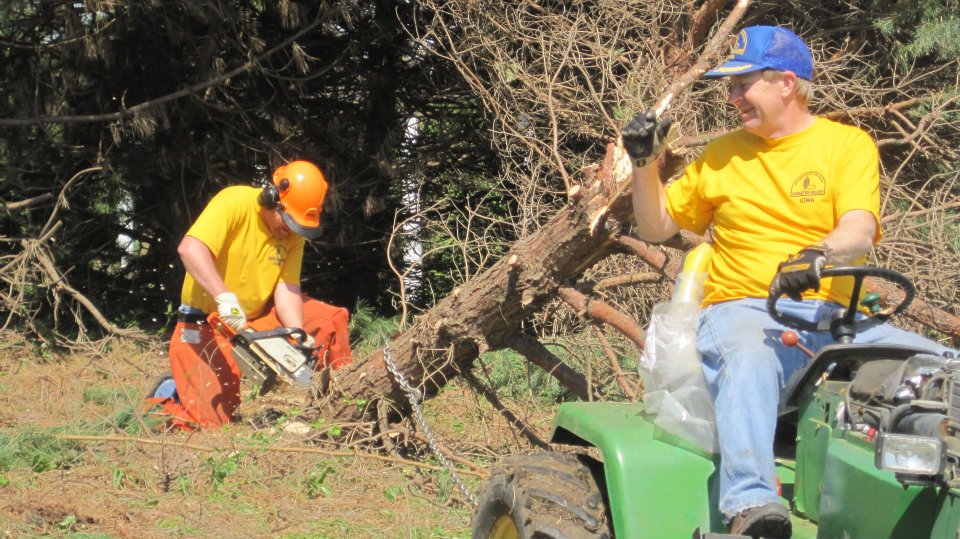
Disaster (Relief) Comes to Creston

Jerry Hartman and Bob Dillman remove damaged tree.

Little did we know that the severe thunderstorm on the evening of April 14 would spawn an EF2 tornado just west of town. It happened so quickly and was rain-wrapped, giving no one the ability to issue a warning. The effects were minimal, given that the tornado skirted the northwest corner of our community. But for those in its path, the damage was devastating.  While we were spared the loss of any precious life, a total of 14 single family homes and 16 multi-family units were severely damaged and two homes in rural Union county destroyed as well. Several outbuildings on farms were destroyed and 40 homes in the area had minor damage. The Greater Regional Medical Center, not only a hospital but also housing all local physicians, took a direct hit and is still not back to inpatient care. The dormitories of Southwestern Community College were also in the path and now sit empty as all the students finish the semester housed in hotels and homes. Creston Community Schools received severe damage, but classes were able to resume the following Wednesday. The YMCA and other local businesses in the path have yet to reopen.

Things looked pretty bleak as darkness fell that Saturday night. But the outpouring of volunteers began immediately. By Sunday morning I was receiving calls from staff of the Baptist Convention of Iowa, asking if our Southern Baptist Disaster Relief units were needed in Creston. Not knowing the full scope of need yet, Wes Jones, Director of Missions, Northwest & Southwest Associations, arrived by 1:30 p.m., to make an assessment, meet with officials and then, mobilize the Chainsaw Unit. Three men from Sioux City joined Wes and Crest Baptist Church’s own Jerry Hartman, a DR trained volunteer. These five spent the next three days assisting residents with tree removal, as well as spreading the Good News of Christ. With each completed job, the homeowner received a Bible and a prayer for God’s continued aid.

Additionally, Pastor Mike Carlson and Associate Cal Callison from First Baptist, Winterset, arrived on Tuesday, serving as Disaster Relief Chaplains. They visited local adult care facilities that were also impacted by the storm.

The saying “It is more blessed to give than to receive” (Acts 20:35) is so true. But those who were on the receiving end of so many volunteers were tremendously blessed in the midst of adversity. Our community continues to be grateful to the many volunteers, including our own Disaster Relief volunteers, who so quickly and selflessly came to the aid of those in need.

Corky Jenkins, Dick Lechtenberger (homeowner), Robert Battles, Wes Jones and Bob Dillman.

Shared Suffering – Shared Glory

No one likes to suffer! But suffering is an inevitability of life. We can get into a lot of discussions about why there is suffering and evil, but that is not going to change the fact that there is suffering. As Christians, we believe that there is general suffering that everyone experiences as a result of man’s (Adam’s) fall and the resulting curse (Genesis 3:14-19). Death, war, famine, disease all fall under this category. But, there is another kind of suffering that Christians experience because of our faith in Christ Jesus. This suffering may manifest itself because: you take a Biblical stand on a moral issue; you live by an ethical standard that is not compromised even when coerced by employer, friend of family member; or you seek to share your conviction that Jesus is the exclusive way, truth and life (John 14:6) and not one of many ways to God.

In Romans 8:17-18, Paul deals with this second kind of suffering:

17 Now if we are children, then we are heirs—heirs of God and co-heirs with Christ, if indeed we share in his sufferings in order that we may also share in his glory. 18 I consider that our present sufferings are not worth comparing with the glory that will be revealed in us.

We talked Sunday about how our shared sufferings with Christ: 1) validate our relationship as children of God; 2) will be temporary (present not eternal); and 3) will add to our reward in the glory that is to come. Then, when our sufferings are complete, we will finally realize the reward of being co-heirs with Christ (2 Corinthians 4:17).

When it comes to suffering, I tend to be a pragmatist. Since I know we are going to suffer, I want to find an answer to the question “what is to be our response to suffering?” I found a paper by a fellow seminary classmate in Apologetics and now a leading biomedical ethicist, C. Ben Mitchell, in which he responded to the question, “From what perspective should Christians view suffering?” [1] I think Mitchell’s comments hit the mark. Let me highlight them.

1. Christians alone understand the cause of suffering. We are better prepared to deal with and endure suffering because we understand its basis as part of the curse. What was “good” in Creation became cursed after Adam and Eve’s sin. As a result of the Fall, all things await the glorious freedom to come (Romans 8:19-21).

2. Christians alone know the Father’s love and purpose in suffering. Our study in Romans is quickly approaching that wonderfully reassuring verse: And we know that in all things God works for the good of those who love him, who have been called according to his purpose (Romans 8:28, NIV). What confidence it gives us to know that God loves us and will use suffering for good. There must, then, be a purpose in our suffering, and it is at least two-fold: to glorify God and conform His children into the image of Jesus.

3. Christians alone have been granted faith to trust God and believe His loving purposes will prevail. While unbelievers may reject the notion of a good and loving God in times of suffering, believers, while not always understanding our present suffering, have faith in the promise of God’s future goodness. Even the long-suffering Job attested:

25 I know that my Redeemer lives,
and that in the end he will stand upon the earth.
26 And after my skin has been destroyed,
yet in my flesh I will see God;
27 I myself will see him
with my own eyes—I, and not another.
How my heart yearns within me! (Job 19:25-27, NIV)

4. Christians have hope; hope that enables them to see through the suffering to the goal of suffering. Just as Jesus, who for the joy set before him endured the cross (Hebrews 12:2), we keep the hope of eternal life in view.

With these things in mind, we may face difficulties, struggles and suffering with a new perspective. Instead of asking “why me?”, we ask “why not me?” When we see the bigger picture of God’s continued love and purpose for our sufferings, our need for refinement and preparation for future glory, then, suffering should be embraced as God’s tool to make us ready for our inheritance. Will we always like suffering? No! But, will we be more willing to accept God’s grace through suffering? Yes!
Your Response:
    • When you consider the times of suffering in your life, can you say that some of it has been because of your identification with Christ? If not, you may have cause to question your “sonship.”
    • In what ways have you seen suffering refine you? In what ways have others seen your actions, words, and attitudes become more like Christ’s as you have gone through difficult times? If you don’t know, ask a family member or close friend if they have seen such transformation.
    • Check out this great video by the Skit Guys entitled God’s Chisel.

_______________________________________________________________

1 C. Ben Mitchell, The SBJT Forum:Biblical Perspectives on Suffering, The Southern Baptist Journal of Theology, Vol 4, Issue 2 (Summer 2000), pp 106-107.

Who’s Your Father?

The question of Jesus’ authority to make the claims He made became increasingly a matter of debate as He approached the cross. And, the more He made it clear that His authority came from the Father, the more the religious leaders wanted to kill Him for blasphemy. John 8 is the account of a number of such encounters that happened in Jerusalem just months before the crucifixion. In this passage we see Jesus not only claim His own unique relationship to the heavenly Father, but He clearly shows the way in which we may know who our father is.

As Jesus made assertions regarding the truthfulness of His testimony, He spoke of the witness of the Father to His claims. When the Pharisees asked where was His father, Jesus responded that if they knew Him, they would know His Father (John 8:12-59). Another time when the religious leaders asserted their family lineage connected them to Father Abraham, Jesus chided them that if they were Abraham’s children they would not try to kill Him. He added that if God was their Father, they would love Jesus. But, Jesus concluded that their murderous desires demonstrated their real parentage, the devil, for “He was a murderer from the beginning” (John 8:44).

According to Jesus, all of mankind has one of two spiritual fathers – the heavenly Father or the devil. While there is neither DNA nor blood testing (although we are blood bought) to prove our relationship to the heavenly Father, there are ways in which His parentage is demonstrated. Let me suggest a few.

From the John 8 text, we see that belief in Jesus is evidence of relationship. Negatively Jesus said, “if you do not believe that I am the one I claim to be, you will indeed die in your sins.” (John 8:24, NIV). He went on to say that the reason He had the right to judge unbelief was because of His relationship to the Father and that: I do nothing on my own but speak just what the Father has taught me (John 8:27, NIV). Ultimately, Jesus predicted that His resurrection would verify this relationship. He also suggested to the unbelievers of His day that the reason they did not believe in Him was that they were deceived by the father of lies, the devil.

44 You belong to your father, the devil, and you want to carry out your father’s desire. He was a murderer from the beginning, not holding to the truth, for there is no truth in him. When he lies, he speaks his native language, for he is a liar and the father of lies. 45 Yet because I tell the truth, you do not believe me! (John 8:44-45, NIV)

Secondly, Jesus said, He who belongs to God hears what God says. The reason you do not hear is that you do not belong to God. (John 8:47, NIV). Hearing from God is another indicator of a relationship to the heavenly Father. Paul spoke of the unique dynamic of spiritual communication, in that, without the Spirit – the seal of relationship – spiritual communication cannot be understood by natural men (1 Corinthians 2:13-14). The Parable of the Soils (Mark 4:1-20) is a lesson on how one hears the Gospel, with Jesus’ conclusion of the parable: “He who has ears to hear, let him hear” (v. 9).

While this list is not exhaustive, I conclude by looking back at our text from Sunday. In Romans 8:13-17, we considered the Spirit’s role in confirming in the life of the believer that God is our heavenly Father. Paul begins that section by saying, if by the Spirit you put to death the misdeeds of the body, you will live, because those who are led by the Spirit of God are sons of God (Romans 8:13-14, NIV) . The leadership of the Spirit gives us confirmation that we are the children of God, as well as being the empowerment within us to mortify the fleshly desires. The Spirit’s leading also brings us intimacy with the Father, so that we can call Him the equivalent of “Daddy.”

YOUR RESPONSE

Who is your Father? Are you able to say with certainty that you believe in Jesus Christ’s claims to be the Son of God, Redeemer and Judge? Do you hear God’s voice, speaking to you through His Word? And is their evidence of the Spirit’s indwelling presence, Who gives you: the power to live; a growing intimacy with the heavenly Father; an assurance in your spirit that you are a child of God; and the certainty that you are an heir of God and co-heir with Jesus Christ? If not, I challenge you to seek that confirmation. In John’s letter, he said:

11 And this is the testimony: God has given us eternal life, and this life is in his Son. 12He who has the Son has life; he who does not have the Son of God does not have life. 13 I write these things to you who believe in the name of the Son of God so that you may know that you have eternal life.
(1 John 5:11-13, NIV)

Responding to Your Debt

Last summer, the U.S. Department of Agriculture released its annual report on what it costs a family to raise a child. It found that “a middle-income” family with a child born in 2010 can expect to spend about $226,920 ($286,860 if projected inflation costs are factored in) for food, shelter, and other necessities to raise that child over the next 17 years.” [1] Can you imagine turning 18 and receiving that bill from your parents?

But, take a minute and think about all the time and money that has been invested in you…from your parents’ expenditures (who provided room and board, clothing, medical care, etc) to the teachers at all levels who sought to impart knowledge and wisdom. What about the volunteer coaches or Sunday school teachers, who gave up many hours to train you in some skill or application of God’s truth? Move into your adult life to think of those mentors from whom you have gained some expertise. Take a moment and write down those names and ways in which you are indebted to these individuals…I’ll wait.

Now, look over that list. Who would you say has made the greatest contribution to your life? That may be a tough question to answer, since some accomplishments in life are achieved only after the multiple influences of others. But, when it comes to here and now, can you point to one individual and say, “I am who I am today because of [insert name]”? If you were able to do that, what do you owe that individual? How could you ever pay back the investment they have made in you? Perhaps a cash payback is out of the question for their influence has been invaluable. Maybe you have already thanked them profusely, but your gratitude seems insufficient. What, then, is the greatest way to honor that debt?

As a parent who spends massive amounts of money on your child(ren), what payback do you really expect? You hope that you will pass on enough life skills so that they aren’t returning home as adults to live with you. You pray that God will give you wisdom to raise them, so that they will follow after Christ and not be alienated from the love of the Father by a faulty representation of Him by their earthly father. So, when that adult child says, in a complimentary fashion, “I’m going to raise my child like I was raised,” there is a sense in which the investment has been paid in full. When one is able to take what you have invested in them and then begins to invest it in others, you gain an invaluable satisfaction!

As we have been examining Romans, we see that we all have a greater obligation [debt]. What we do and what we receive from God has obligated us in serious ways. While Paul has previously spoken of the unbeliever’s sin debt that brings eternal death (Romans 6:23), Paul speaks now of the believer’s obligation to “live” in Romans 8:12-13:

12 Therefore, brothers, we have an obligation—but it is not to the sinful nature, to live according to it. 13 For if you live according to the sinful nature, you will die; but if by the Spirit you put to death the misdeeds of the body, you will live…

In these two verses, Paul clearly states “we have an obligation.” Our obligation is not to the flesh; he implies our obligation is to the Spirit since life in the Spirit is the context of these verses. And with that debt to the Spirit comes the necessity of mortifying, putting to death the deeds of the flesh; that is, all of the selfish, self-directed, anti-God behavior of our sinful nature. As that daily denial of self happens, real living begins to happen. The life that God intended us to have in uninterrupted communion with Him begins to be realized. But, it takes more than will-power to “put to death the misdeeds of the body.” Paul suggests that it is by the Spirit, Who resides within us, with all of the resources of God.

Therefore, our indebtedness to the Lord for the great cost expended on us for salvation is best “paid back” when we live by the Spirit of God, as evidenced by putting to death the deeds of the flesh. We then begin taking on more of the resemblance of Christ in word and deed and “re”-presenting Him through our lives to the world around us.

________________________________________

1 This is the press release of the USDA, June 2011 report “Expenditure on Children by Families.” Complete report can be linked from here: http://www.usda.gov/wps/portal/usda/usdahome contentid=2011/06/0241.xml&contentidonly=true

For Fun:

The Nathaniel Hawthorne short story, The Great Stone Face, is a wonderful tale of one whose focus is so determined on an item that he begins to take on the very character and nature of that desired object. There is great spiritual application in this story. Read it online HERE

Here is a link to a USDA calculator that estimates the cost of raising a child based on region http://www.cnpp.usda.gov/calculatorintro.htm

The New Way of the Spirit

As we talked on Sunday about our life in the Spirit in Romans 8:5-11, I was reminded about the first teaching I can remember of the Spirit-filled life. I was a 15 year old, who reluctantly went to my church’s youth camp in the Great Smoky Mountains near Gatlinburg, TN. While I was involved in the regular activities of my church, I didn’t participate in the extras (youth choir, youth trips, etc.) because I was more of a band geek, not very athletic and somewhat introverted. I thought I would be out of my comfort zone at camp, but since our pastor, Herb Hodges, was leading the teaching sessions, my parents encouraged me to go.

In his sessions, I remember Herb teaching with a chalk board – writing outlines, Greek words and drawing illustrations. One of those sessions portrayed three circles, each with a chair [throne] in the middle.[1]  We were told that the circles represented three different types of people – the non-Christian, the Christian and the carnal Christian. Each illustration had an “S” for self and a cross to represent Christ. Additionally, small dots within the circle represented the various decisions and activities of life.

The first circle had the “S” on the chair with Christ outside of the circle. The dots inside the circle were in disarray, representing a life that was out of control. This depicted the life of the unsaved, who was living the self-directed life. Whether out of ignorance or rebelliousness, this individual had not yielded his life to the Lordship of Jesus Christ. Consequently, the dots inside the circle were in disarray, representing the inability of man to really control life under his own power.

The second circle was one in which Jesus sat on the throne and self was at the feet of the throne. In this circle, the dots were in an orderly form, representing the life of a Christian under the control of the Spirit.

The final circle pictured Christ still in the circle, but He had been dethroned by the “S”. Once again, the dots were in disarray…a life in chaos without the controlling nature of the Spirit of Christ on the throne. The carnal believer, one walking in his own power and self-direction, but nevertheless saved, was represented by this circle.

When pressed with the question, “Which circle best represents you?”, I knew that it was not the Spirit-filled believer. In fact, I was not even sure that I had ever really experienced salvation.[2]  I made a decision that night to have Christ on the throne of my life and to seek the life of obedience to Christ through the enabling power of the Holy Spirit, filling my life. This teaching revolutionized my understanding of God’s expectations for me. I was no longer under the impression that I was on my own when it came to living for Christ. He had given me His help and power if I would only choose against myself and choose Him.

Youth camp provided some additional dividends. I made connections with some older youth beyond by own grade, who accepted me and provided me with some of the important accountability touches that were needed outside the church setting. Did I (and, do I) still blow it at times? Yes! But, praise the Lord, He is faithful in forgiving, restoring and enabling His children to follow after Him!

YOUR RESPONSE

  • On the night before His death Jesus spoke of the coming of the Holy Spirit. He explained the role, which the Spirit would have in the life of believers. Read through John 14-16 and write down what each chapter says about the function of the Spirit.
  • Ephesians 5:18 is often used as an admonition to avoid the use of alcohol. It is more an issue of control. You are going to be controlled by something or Somebody. Are you going to be controlled (filled) by the Holy Spirit, or are you going to be controlled by a substance, a hurt, a hang-up or a habit? Think about your life. What or who is in control right now?
  • Galatians 5:16-25 is a great passage to contrast between the sinful nature and the life in the Spirit. Compare the lists and consider which best describes your life. Ask God to begin to manifest more of the fruit of the Spirit in your life as you keep in step with the Spirit.

_________________________________________________________________________

1 This was not original with Herb, but is published by Campus Crusade for Christ. Here is a link to the online version (and illustrations) of Have You Made the Wonderful Discovery of the Spirit-Filled Life? You would be wise to master such illustrations, enabling you to have “napkin drawings” with family and friends at the dinner or restaurant table as God directs the conversation to spiritual matters.

2 Having made a profession of faith at age 7, I did not have the intellectual capacity to understand the more abstract concepts of the Lordship of Christ and its implications for my life. So, as a 15 year old, those concepts were now connecting and resonating in my mind and heart. Looking back from adulthood, I believe my early conversion was valid, and I committed as much as I knew of Chuck to as much as I knew of God at age 7 (which at the time was more of the saving role of Christ). Due to a lack of understanding (or the lack of teaching), I thought I was on my own to live in obedience to God by rule keeping and will power. What a relief to experience the life of the Spirit!