Disaster (Relief) Comes to Creston

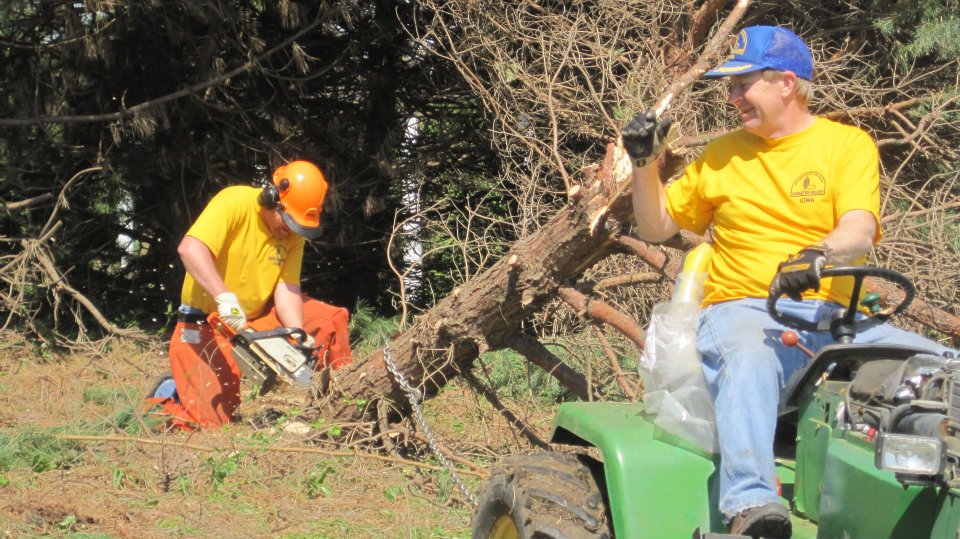
Jerry Hartman and Bob Dillman remove damaged tree.

Little did we know that the severe thunderstorm on the evening of April 14 would spawn an EF2 tornado just west of town. It happened so quickly and was rain-wrapped, giving no one the ability to issue a warning. The effects were minimal, given that the tornado skirted the northwest corner of our community. But for those in its path, the damage was devastating.  While we were spared the loss of any precious life, a total of 14 single family homes and 16 multi-family units were severely damaged and two homes in rural Union county destroyed as well. Several outbuildings on farms were destroyed and 40 homes in the area had minor damage. The Greater Regional Medical Center, not only a hospital but also housing all local physicians, took a direct hit and is still not back to inpatient care. The dormitories of Southwestern Community College were also in the path and now sit empty as all the students finish the semester housed in hotels and homes. Creston Community Schools received severe damage, but classes were able to resume the following Wednesday. The YMCA and other local businesses in the path have yet to reopen.

Things looked pretty bleak as darkness fell that Saturday night. But the outpouring of volunteers began immediately. By Sunday morning I was receiving calls from staff of the Baptist Convention of Iowa, asking if our Southern Baptist Disaster Relief units were needed in Creston. Not knowing the full scope of need yet, Wes Jones, Director of Missions, Northwest & Southwest Associations, arrived by 1:30 p.m., to make an assessment, meet with officials and then, mobilize the Chainsaw Unit. Three men from Sioux City joined Wes and Crest Baptist Church’s own Jerry Hartman, a DR trained volunteer. These five spent the next three days assisting residents with tree removal, as well as spreading the Good News of Christ. With each completed job, the homeowner received a Bible and a prayer for God’s continued aid.

Additionally, Pastor Mike Carlson and Associate Cal Callison from First Baptist, Winterset, arrived on Tuesday, serving as Disaster Relief Chaplains. They visited local adult care facilities that were also impacted by the storm.

The saying “It is more blessed to give than to receive” (Acts 20:35) is so true. But those who were on the receiving end of so many volunteers were tremendously blessed in the midst of adversity. Our community continues to be grateful to the many volunteers, including our own Disaster Relief volunteers, who so quickly and selflessly came to the aid of those in need.

Corky Jenkins, Dick Lechtenberger (homeowner), Robert Battles, Wes Jones and Bob Dillman.

Shared Suffering – Shared Glory

No one likes to suffer! But suffering is an inevitability of life. We can get into a lot of discussions about why there is suffering and evil, but that is not going to change the fact that there is suffering. As Christians, we believe that there is general suffering that everyone experiences as a result of man’s (Adam’s) fall and the resulting curse (Genesis 3:14-19). Death, war, famine, disease all fall under this category. But, there is another kind of suffering that Christians experience because of our faith in Christ Jesus. This suffering may manifest itself because: you take a Biblical stand on a moral issue; you live by an ethical standard that is not compromised even when coerced by employer, friend of family member; or you seek to share your conviction that Jesus is the exclusive way, truth and life (John 14:6) and not one of many ways to God.

In Romans 8:17-18, Paul deals with this second kind of suffering:

17 Now if we are children, then we are heirs—heirs of God and co-heirs with Christ, if indeed we share in his sufferings in order that we may also share in his glory. 18 I consider that our present sufferings are not worth comparing with the glory that will be revealed in us.

We talked Sunday about how our shared sufferings with Christ: 1) validate our relationship as children of God; 2) will be temporary (present not eternal); and 3) will add to our reward in the glory that is to come. Then, when our sufferings are complete, we will finally realize the reward of being co-heirs with Christ (2 Corinthians 4:17).

When it comes to suffering, I tend to be a pragmatist. Since I know we are going to suffer, I want to find an answer to the question “what is to be our response to suffering?” I found a paper by a fellow seminary classmate in Apologetics and now a leading biomedical ethicist, C. Ben Mitchell, in which he responded to the question, “From what perspective should Christians view suffering?” [1] I think Mitchell’s comments hit the mark. Let me highlight them.

1. Christians alone understand the cause of suffering. We are better prepared to deal with and endure suffering because we understand its basis as part of the curse. What was “good” in Creation became cursed after Adam and Eve’s sin. As a result of the Fall, all things await the glorious freedom to come (Romans 8:19-21).

2. Christians alone know the Father’s love and purpose in suffering. Our study in Romans is quickly approaching that wonderfully reassuring verse: And we know that in all things God works for the good of those who love him, who have been called according to his purpose (Romans 8:28, NIV). What confidence it gives us to know that God loves us and will use suffering for good. There must, then, be a purpose in our suffering, and it is at least two-fold: to glorify God and conform His children into the image of Jesus.

3. Christians alone have been granted faith to trust God and believe His loving purposes will prevail. While unbelievers may reject the notion of a good and loving God in times of suffering, believers, while not always understanding our present suffering, have faith in the promise of God’s future goodness. Even the long-suffering Job attested:

25 I know that my Redeemer lives,
and that in the end he will stand upon the earth.
26 And after my skin has been destroyed,
yet in my flesh I will see God;
27 I myself will see him
with my own eyes—I, and not another.
How my heart yearns within me! (Job 19:25-27, NIV)

4. Christians have hope; hope that enables them to see through the suffering to the goal of suffering. Just as Jesus, who for the joy set before him endured the cross (Hebrews 12:2), we keep the hope of eternal life in view.

With these things in mind, we may face difficulties, struggles and suffering with a new perspective. Instead of asking “why me?”, we ask “why not me?” When we see the bigger picture of God’s continued love and purpose for our sufferings, our need for refinement and preparation for future glory, then, suffering should be embraced as God’s tool to make us ready for our inheritance. Will we always like suffering? No! But, will we be more willing to accept God’s grace through suffering? Yes!
Your Response:
    • When you consider the times of suffering in your life, can you say that some of it has been because of your identification with Christ? If not, you may have cause to question your “sonship.”
    • In what ways have you seen suffering refine you? In what ways have others seen your actions, words, and attitudes become more like Christ’s as you have gone through difficult times? If you don’t know, ask a family member or close friend if they have seen such transformation.
    • Check out this great video by the Skit Guys entitled God’s Chisel.

_______________________________________________________________

1 C. Ben Mitchell, The SBJT Forum:Biblical Perspectives on Suffering, The Southern Baptist Journal of Theology, Vol 4, Issue 2 (Summer 2000), pp 106-107.

Who’s Your Father?

The question of Jesus’ authority to make the claims He made became increasingly a matter of debate as He approached the cross. And, the more He made it clear that His authority came from the Father, the more the religious leaders wanted to kill Him for blasphemy. John 8 is the account of a number of such encounters that happened in Jerusalem just months before the crucifixion. In this passage we see Jesus not only claim His own unique relationship to the heavenly Father, but He clearly shows the way in which we may know who our father is.

As Jesus made assertions regarding the truthfulness of His testimony, He spoke of the witness of the Father to His claims. When the Pharisees asked where was His father, Jesus responded that if they knew Him, they would know His Father (John 8:12-59). Another time when the religious leaders asserted their family lineage connected them to Father Abraham, Jesus chided them that if they were Abraham’s children they would not try to kill Him. He added that if God was their Father, they would love Jesus. But, Jesus concluded that their murderous desires demonstrated their real parentage, the devil, for “He was a murderer from the beginning” (John 8:44).

According to Jesus, all of mankind has one of two spiritual fathers – the heavenly Father or the devil. While there is neither DNA nor blood testing (although we are blood bought) to prove our relationship to the heavenly Father, there are ways in which His parentage is demonstrated. Let me suggest a few.

From the John 8 text, we see that belief in Jesus is evidence of relationship. Negatively Jesus said, “if you do not believe that I am the one I claim to be, you will indeed die in your sins.” (John 8:24, NIV). He went on to say that the reason He had the right to judge unbelief was because of His relationship to the Father and that: I do nothing on my own but speak just what the Father has taught me (John 8:27, NIV). Ultimately, Jesus predicted that His resurrection would verify this relationship. He also suggested to the unbelievers of His day that the reason they did not believe in Him was that they were deceived by the father of lies, the devil.

44 You belong to your father, the devil, and you want to carry out your father’s desire. He was a murderer from the beginning, not holding to the truth, for there is no truth in him. When he lies, he speaks his native language, for he is a liar and the father of lies. 45 Yet because I tell the truth, you do not believe me! (John 8:44-45, NIV)

Secondly, Jesus said, He who belongs to God hears what God says. The reason you do not hear is that you do not belong to God. (John 8:47, NIV). Hearing from God is another indicator of a relationship to the heavenly Father. Paul spoke of the unique dynamic of spiritual communication, in that, without the Spirit – the seal of relationship – spiritual communication cannot be understood by natural men (1 Corinthians 2:13-14). The Parable of the Soils (Mark 4:1-20) is a lesson on how one hears the Gospel, with Jesus’ conclusion of the parable: “He who has ears to hear, let him hear” (v. 9).

While this list is not exhaustive, I conclude by looking back at our text from Sunday. In Romans 8:13-17, we considered the Spirit’s role in confirming in the life of the believer that God is our heavenly Father. Paul begins that section by saying, if by the Spirit you put to death the misdeeds of the body, you will live, because those who are led by the Spirit of God are sons of God (Romans 8:13-14, NIV) . The leadership of the Spirit gives us confirmation that we are the children of God, as well as being the empowerment within us to mortify the fleshly desires. The Spirit’s leading also brings us intimacy with the Father, so that we can call Him the equivalent of “Daddy.”

YOUR RESPONSE

Who is your Father? Are you able to say with certainty that you believe in Jesus Christ’s claims to be the Son of God, Redeemer and Judge? Do you hear God’s voice, speaking to you through His Word? And is their evidence of the Spirit’s indwelling presence, Who gives you: the power to live; a growing intimacy with the heavenly Father; an assurance in your spirit that you are a child of God; and the certainty that you are an heir of God and co-heir with Jesus Christ? If not, I challenge you to seek that confirmation. In John’s letter, he said:

11 And this is the testimony: God has given us eternal life, and this life is in his Son. 12He who has the Son has life; he who does not have the Son of God does not have life. 13 I write these things to you who believe in the name of the Son of God so that you may know that you have eternal life.
(1 John 5:11-13, NIV)